EN
EN CN
CN
Central Asia’s Heart Failure Care Market 2027: A Profitable Blue Ocean for Medical Distributors

Introduction: Stop Competing on Low-Margin Single Devices
For medical equipment distributors across Central Asia, the market for basic patient monitors, standalone ECG machines, and entry-level ultrasound devices has become highly saturated. Price competition is fierce, margins are shrinking, and differentiation is increasingly difficult.
The real next growth engine is integrated cardiovascular and heart failure care solutions— a high-demand, underserved segment that local hospitals are actively upgrading. Bundled clinical solution sales deliver higher deal values, stronger customer stickiness, and far less competition.
In this article, we break down why Central Asia’s heart failure market is a worthy long-term investment, and how our cost-effective grassroots solution captures this opportunity.
Looking for the high-end specialist package? Read our guide to the tertiary hospital cardiac care market →High-End Cardiac Care in Central Asia
1. Why Invest in Central Asia Heart Failure Care?
Key Takeaways
| Distributor Question | Short Answer |
|---|---|
| Patient demand | Real, documented, and growing |
| Clinical infrastructure | Not ready — major gaps remain |
| Market growth | Above the global average |
| Competition | Almost none in integrated solutions |
| Funding | World Bank, ADB, and national health strategies committed |
| Timing | Early-stage market, exclusive agency still available |
The Evidence Behind Each Answer
Patient demand is real and documented.
According to a national electronic health system study published in the European Journal of Public Health, Kazakhstan alone recorded over half a million registered heart failure patients between 2014 and 2019. All-cause mortality nearly tripled over the observation period, with hypertension as the most common comorbidity.
A separate systematic review in Epidemiologia confirms cardiovascular morbidity and prevalence are rising across Central Asia — while noting that surveillance remains limited in several countries, meaning the true burden may be underestimated.
Clinical infrastructure has not kept pace.
Local gaps are consistent across the region:
- Most regional hospitals only have basic bedside monitors and standalone ECG devices. No continuous cardiac monitoring for ambulatory heart failure patients after stabilization.
- Emergency departments lack bedside ultrasound (POCUS) to quickly distinguish acute heart failure pulmonary edema from pneumonia.
- Almost no local supplier provides a one-stop heart failure full-course management solution. Devices are purchased separately, creating fragmented workflows and wasted resources.
The market is growing above the global average.
IndexBox projects Central Asia’s wireless cardiac monitoring market growing at roughly9.5% CAGRthrough 2035, while Mordor Intelligence reports the ECG market in Kazakhstan, Uzbekistan, and Tajikistan growing at around6% CAGRthrough 2030.
IndexBox Report | Mordor Intelligence Report
Competition in integrated solutions is almost nonexistent.
- Global giants(Philips, GE) only target high-end top-tier hospitals with ultra-high prices, slow after-sales, and no localized bundled solutions.
- Mainstream Chinese brandsfocus on single bedside monitor and ultrasound sales, lacking core telemetry system layout and complete heart failure clinical workflow packages.
- Result:No dominant integrated solution supplier exists in Central Asia today.
Funding is already committed.
Uzbekistan’s national “Health 2030” strategy, supported by World Bank and ADB loans, focuses on upgrading cardiology departments, CCUs, and emergency systems for secondary and tertiary hospitals — creating large-scale batch procurement demands.
Kazakhstan’s mature private medical institutions and upgraded state-level hospitals have sufficient budgets. Kyrgyzstan and Tajikistan depend on international medical aid and government grassroots renovation projects, with stable demand for cost-effective standardized packages.
2. Our Solution: Cost-Effective Grassroots Heart Failure Package
For Secondary Hospitals & Aid Projects
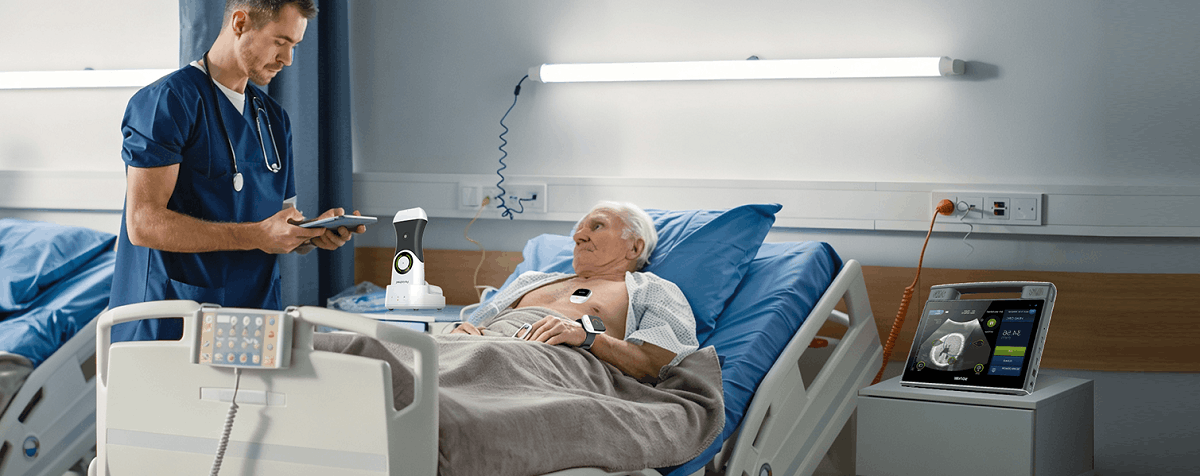
What's in the Package
| Component | Clinical Role |
|---|---|
| Wireless Handheld Ultrasound | Rapid POCUS bedside diagnosis — cardiac EF value and pulmonary B-line to identify acute heart failure |
| Standard Bedside Patient Monitor | Real-time vital signs tracking for inpatient monitoring |
| 12-Lead ECG Machine | Excluding myocardial infarction and atrial fibrillation |
| In-Hospital Cardiac Telemetry System | Continuous ward monitoring for heart failure patients — new product, pre-launch stage |
Who It's For
This package is designed for the grassroots segment of Central Asia's cardiac care market — hospitals and projects that need a complete clinical workflow but cannot justify high-end specialist pricing.
- Regional secondary hospitals— need full-process diagnosis and monitoring without a high-end budget
- District medical centers— standardized configuration for cardiology ward upgrade
- Emergency departments— POCUS plus ECG for rapid acute heart failure screening
- World Bank / ADB funded projects— batch procurement-ready, standardized package
- Kyrgyzstan and Tajikistan grassroots institutions— cost-effective, Russian-localized, low training threshold
Distributor Value at a Glance
| Distributor Priority | What This Package Delivers |
|---|---|
| Ease of selling | Complete clinical story — not just a device list |
| Profit margin | Bundled pricing, less price-sensitive than single-device sales |
| Hospital acceptance | Full Russian UI, localized workflow, fits local practice |
| Long-term business | Ward-level solution. After-sales, upgrades, and matching orders follow |
| Technical threshold | Low. We provide training, marketing materials, and after-sales support |
| Exclusivity | Pre-order quota and regional exclusive agency for the new telemetry line |
| Customer coverage | Covers the grassroots segment that high-end brands ignore |
| Market trend | Early-stage blue ocean with rising demand and low competition |
New Product Preemptive Layout: In-Hospital Cardiac Telemetry System
Our pre-launch in-hospital cardiac telemetry system is a blank-market exclusive for Central Asia, opening pre-order quota only for exclusive regional distributors. It supports flexible customization and comes with priority delivery and regional exclusive agency authorization — helping early partners lock in the local telemetry market with high-margin batch orders.
FAQ for Distributors
Q: Is this package only for government projects?
A: No. It fits government bidding and international aid batch procurement, but also works for individual secondary hospitals and district medical centers upgrading their cardiology wards.
Q: What localization and training support is included?
A: Full Russian UI and localized operation logic, plus Russian brochures, clinical PPT, and solution cases. We also provide professional clinical training — heart failure POCUS diagnosis and telemetry ward application — plus after-sales spare parts support.
Q: Can we get exclusivity for our region?
A: Yes. The new telemetry product operates on a limited regional exclusive agency mechanism. Early partners can lock in their territory.
The Bottom Line
You are not selling four devices. You are selling acomplete grassroots heart failure workflow— with a new telemetry line that no local competitor can offer yet.
3. Core Competitive Advantages of Our Solutions
| Distributor Priority | Typical Local Suppliers | Our Integrated Solution |
|---|---|---|
| Ease of selling | Single devices. Hard to differentiate, buyers compare on price only | Complete clinical solution. Easier to present, easier to close |
| Profit margin | Thin margins. Pure price war | Higher deal values. Bundled pricing is less price-sensitive |
| Hospital acceptance | Fragmented purchases. No clear clinical story | Full Russian UI, localized workflow, fits local hospital practice |
| Long-term business | One-off device sales. Customer easily switches | Ward-level solution. Once installed, after-sales and upgrades follow |
| Technical threshold | Often high. Distributor must figure out clinical details alone | Low. We provide training, marketing materials, and after-sales support |
| Customer coverage | Usually one segment only | Two tiers — grassroots packages and high-end specialist packages |
| Exclusivity | None. Anyone can sell the same device | Regional exclusive agency for the new telemetry line |
| Market trend | Saturated single-device market | Early-stage blue ocean with rising demand and low competition |
The Bottom Line
You are not buying a device. You are positioning yourself as theonly integrated heart failure solution providerin your region — before the market gets crowded.
4. Long-Term Investment Return for Distributors
Central Asia’s heart failure care upgrade is a sustained incremental market, not a short-term hot trend.
- Saturated single-device markets can only bring meager profits, while integrated clinical solutions build your exclusive agency barrier in the local cardiology equipment track.
- Hospital customers have strong stickiness to bundled solutions. Once the ward is upgraded, long-term after-sales maintenance, equipment renewal, and iterative matching orders follow.
- As local medical standards rise, demand for high-end cardiac monitoring and diagnosis will keep increasing, bringing sustainable profit growth for forward-layout distributors.
Conclusion
Central Asia’s heart failure care market is still wide open — low competition, rising demand, and committed healthcare funding. The distributors who move first into integrated solutions will define the category and lock in the highest-margin segment.
Ready to explore exclusive regional agency?
Contact us at [email protected] to discuss distributor opportunities in Uzbekistan, Kazakhstan, Kyrgyzstan, and Tajikistan.
Interested in exclusive regional distribution?
Reach out to us at
[email protected]